
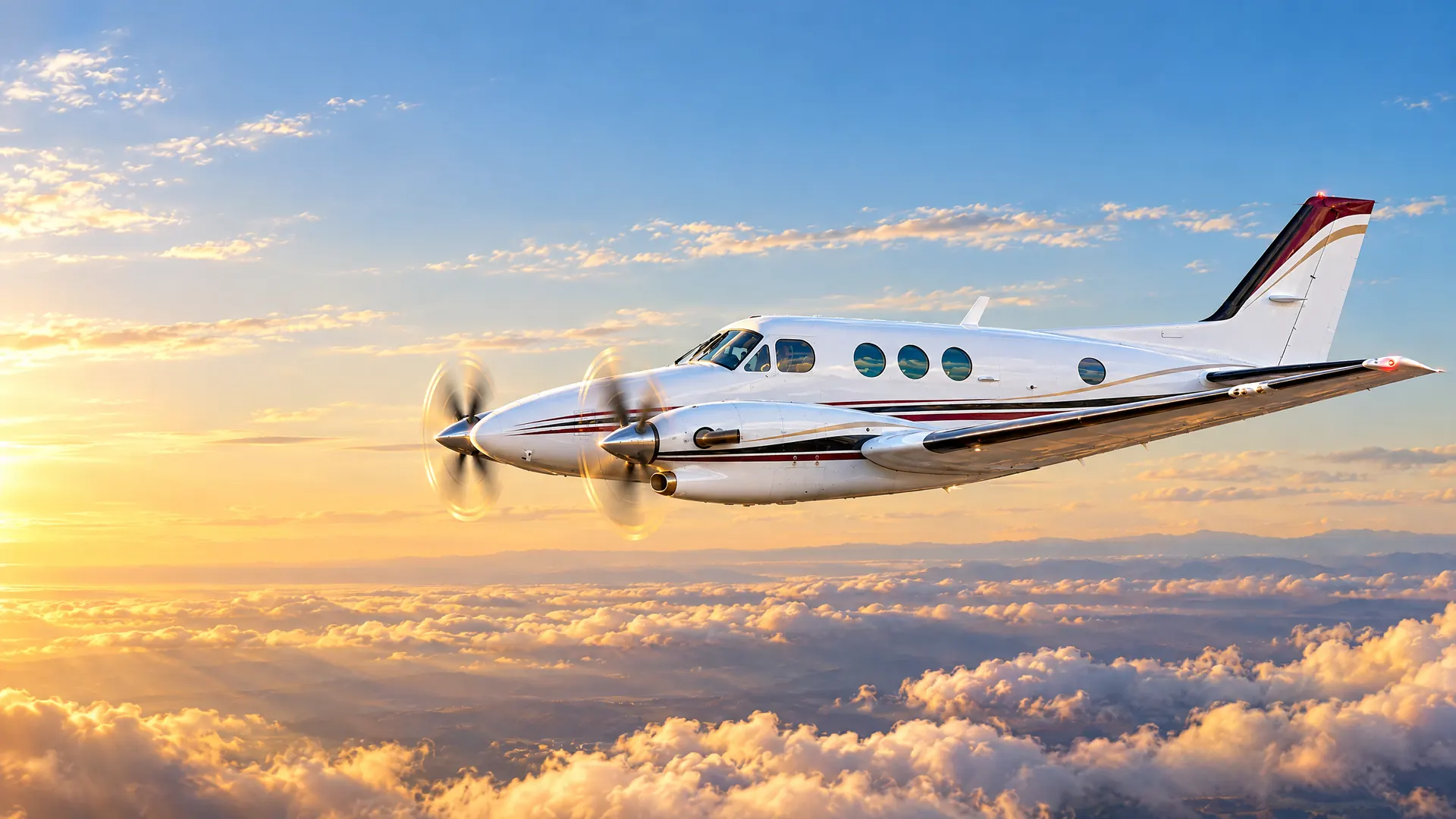
- Twin turboprop
- Pressurized cabin
- Up to 5 passengers
King Air C90: Specs, Interior and Charter
The Beechcraft King Air C90 is a pressurized turboprop for small groups on regional trips, with access to countryside airports. See the aircraft data and request a quote.
- passengers in layouts registered in Brazil
- 5
- reference cruise at 10,000 ft
- 411 km/h
- maximum altitude, pressurized cabin
- 30,000 ft
- Pratt & Whitney PT6A engines
- 2 × 550 shp
The King Air C90 for regional travel
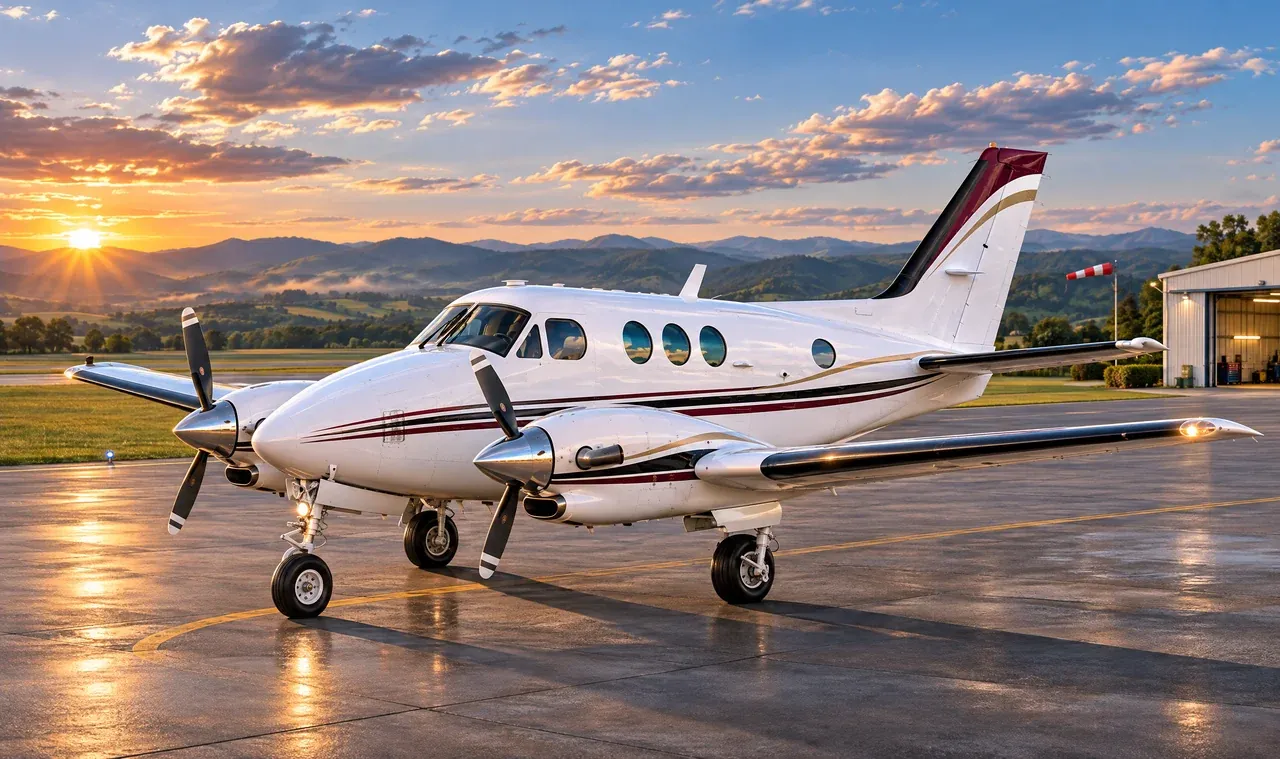
The Beechcraft King Air C90 is a twin-engine business turboprop with a pressurized cabin. The original model has 550 shp per engine and is found in five-passenger layouts, as shown by aircraft registered in Brazil. In a cruise scenario from the Beechcraft manual, it flies at 222 knots, about 411 km/h.
It suits regional trips for small groups: client visits, appointments in countryside towns and family travel. When comparing aircraft for this kind of trip, consider how long the group takes to reach the departure airport and how far they still need to drive after landing.
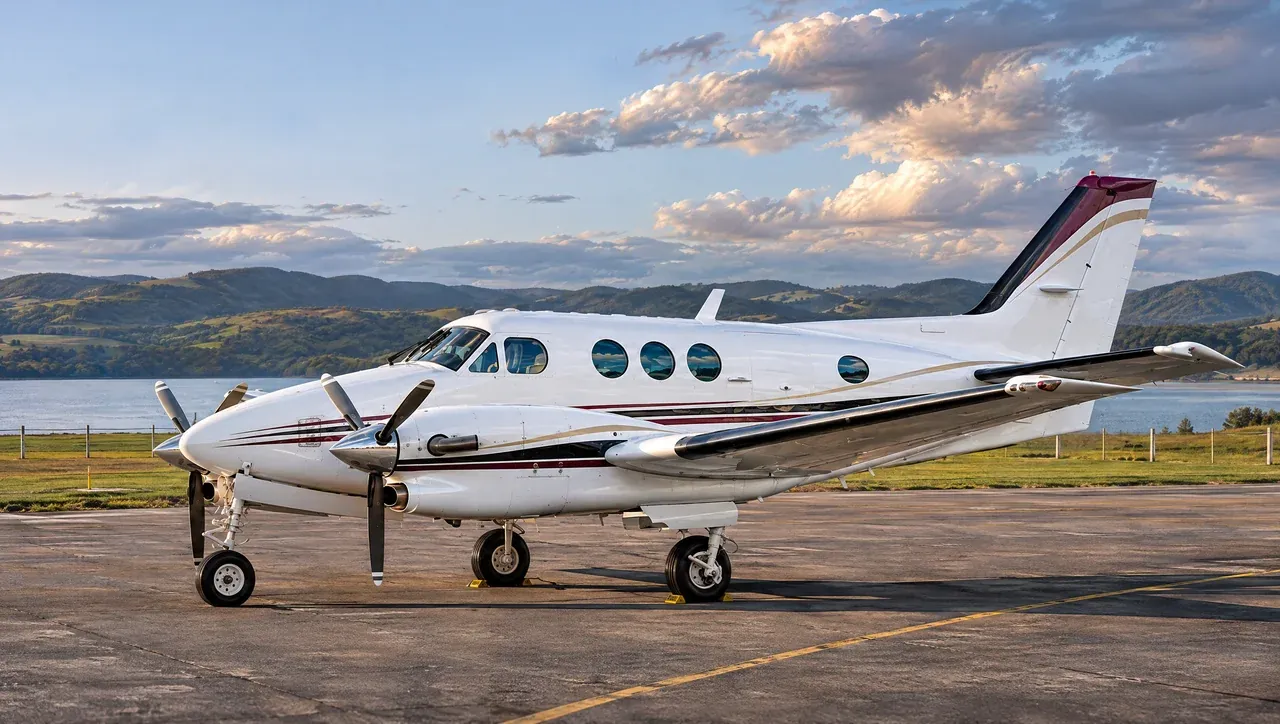
King Air C90 vs. C90GTx
The C90 belongs to the King Air 90 series, ICAO designator BE9L. Depending on the serial number, it uses Pratt & Whitney Canada PT6A-20, PT6A-20A or PT6A-21 engines, all rated at 550 shp.
The King Air C90GTx is a later evolution of the series, delivered from 2010, with PT6A-135A engines, composite winglets and a maximum takeoff weight of 10,485 lb (about 4,756 kg). Textron publishes 272 knots of maximum cruise speed and 1,260 nm (about 2,334 km) of maximum range with NBAA IFR reserves. When comparing proposals, check the version and the estimated performance for your trip.
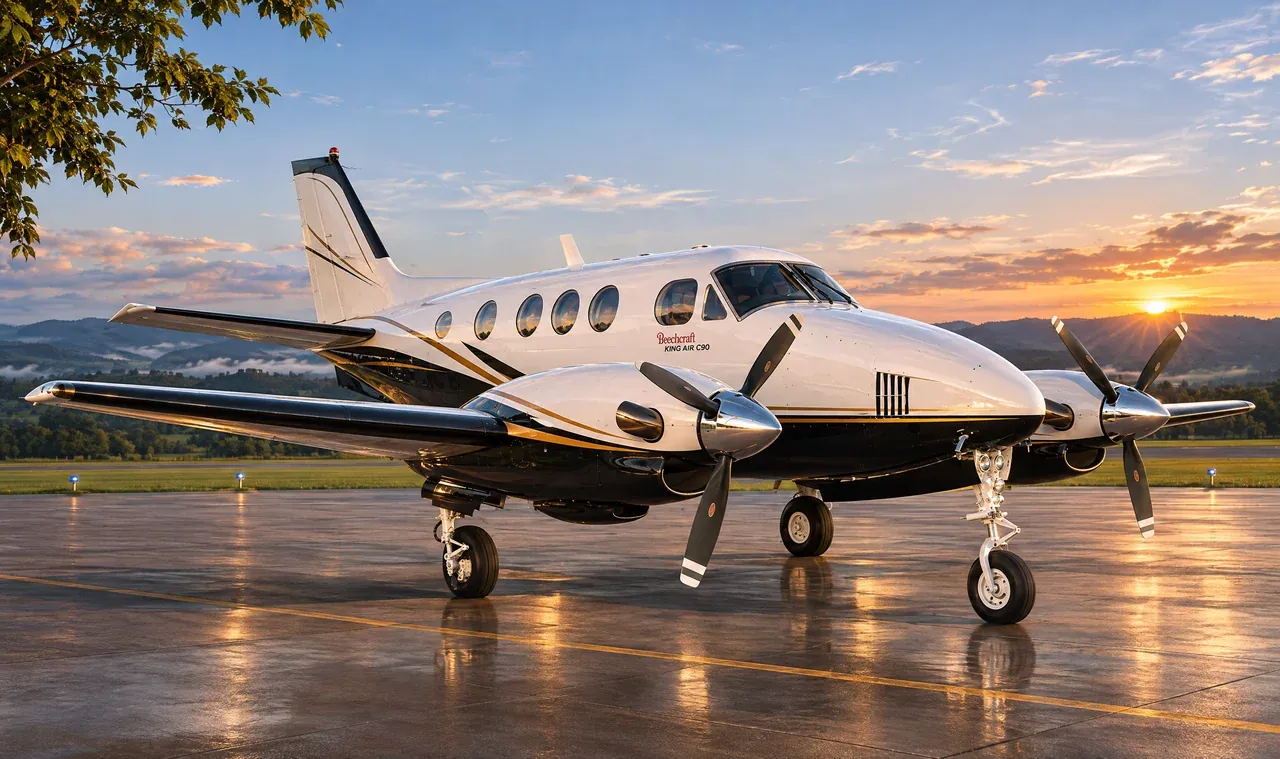
King Air C90 specifications
| Specification | Reference value |
|---|---|
| Manufacturer | Beechcraft |
| Model | C90, King Air 90 series |
| ICAO designator | BE9L |
| Category | Twin-engine business turboprop |
| Cabin | Pressurized |
| Passenger capacity | 5 in layouts registered in Brazil |
| Engines | 2 × Pratt & Whitney Canada PT6A series, by serial number |
| Reference engines | PT6A-20, PT6A-20A or PT6A-21 |
| Power | 550 shp per engine |
| Reference cruise speed | 222 kt (approx. 411 km/h) at 10,000 ft and 8,500 lb, ISA |
| Maximum operating altitude | 30,000 ft (9,144 m) |
| Maximum takeoff weight | 9,650 lb (approx. 4,377 kg) |
| Length | 10.82 m |
| Wingspan | 15.32 m |
| Height | 4.34 m |
The table is based on the original C90. Engines, capacity and weight limits may vary with serial number and modifications. The cruise figure comes from a specific flight manual scenario.
What is the King Air C90 range?
The King Air C90 range depends on weight on board, cruise power, winds and fuel reserves. In an NTSB study, a C90 flew about 920 nm, roughly 1,700 km, on a specific flight with three passengers.
To know if your itinerary can be flown nonstop, the estimate considers the available aircraft, the chosen airports and the expected load.
How far the King Air C90 flies from Curitiba
Straight-line distances from Afonso Pena Airport, compared with the aircraft’s reference range.
- Florianópolis250 km — Within reference range
- São Paulo330 km — Within reference range
- Porto Alegre530 km — Within reference range
- Foz do Iguaçu530 km — Within reference range
- Rio de Janeiro680 km — Within reference range
- Asunción840 km — Within reference range
- Belo Horizonte850 km — Within reference range
- Brasília1,080 km — Within reference range
- Punta del Este1,180 km — Within reference range
- Buenos Aires1,370 km — Fuel stop to be assessed
- Salvador1,810 km — Fuel stop to be assessed
- Recife2,450 km — Fuel stop to be assessed
The actual route is longer than a straight line. Whether a leg can be flown nonstop depends on passengers, baggage, winds and fuel reserves, all assessed in the quote.
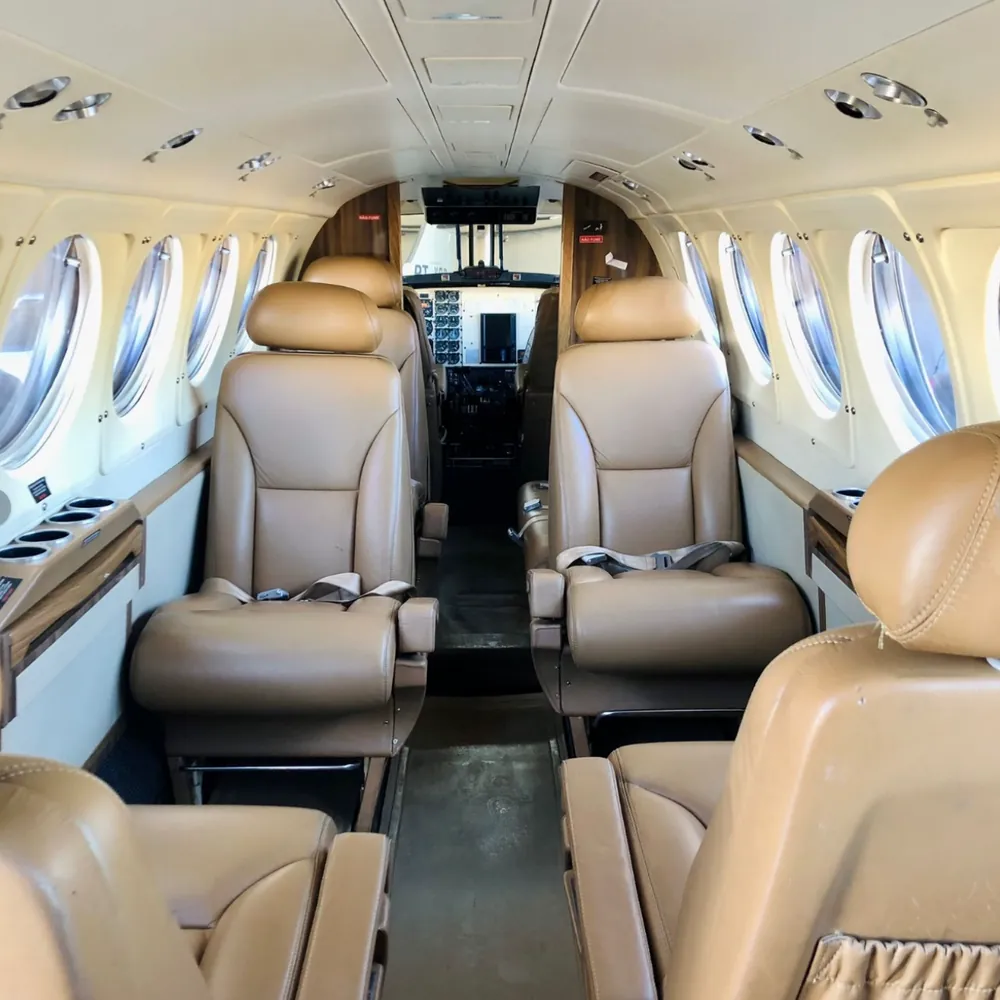
King Air C90 interior
The King Air C90 has a pressurized, compact cabin with leather executive seats. Seat layout and baggage space vary between aircraft. If everyone must travel in the main cabin or the group carries hard cases, golf bags or equipment, mention it in your request.
For a same-day business trip, the C90 suits a small team with light baggage. On a multi-day trip, baggage volume and the fuel needed for the leg may influence the choice of aircraft.
When to charter a King Air C90
The C90 suits groups of up to five on regional legs, when the destination is far from an airline airport or the schedule needs flexibility. Its pressurized cabin flies above much of the weather, more comfortably than a piston twin.
It can operate at regional airports that match the required performance. Runway length, elevation, temperature and weight are assessed; include your preferred airport in the quote.
Request a King Air C90 quote from Aviattion
Know where you want to fly? Send your itinerary to Aviattion to check King Air C90 availability and receive a charter proposal.
How much does it cost to charter a King Air C90?
King Air C90 charter prices are calculated per itinerary. Origin, destination, dates, availability and any positioning affect the quote, as does the time between legs on a round trip.
To receive a quote from Aviattion, send the departure city or airport, destination, dates, number of passengers and expected baggage.
How to charter with Aviattion
- 01Send your itineraryOrigin, destination, dates, times and number of passengers.
- 02Get your proposalAvailable aircraft, estimated flight time and total price.
- 03Confirm the flightWe handle flight planning and operational approvals.
- 04BoardArrive shortly before departure and take off with no queues.
What goes into the quote
- Origin, destination and stops along the way
- Dates, times and the gap between outbound and return
- Number of passengers and baggage
- Aircraft availability and positioning
- Airport fees and crew overnight stays
Compare the aircraft in our fleet
Reference values for each model. The right aircraft depends on the route, the number of passengers and the baggage.
| Aircraft | Type | Passengers | Cruise speed | Reference range | View specs |
|---|---|---|---|---|---|
| Hawker 400XP | Light business jet | 7 | 833 km/h | 2,711 km | View specs → |
| Citation Ultra V | Light business jet | 8 | 741 km/h | 2,593 km | View specs → |
| King Air B200 | Twin turboprop | 7 | 535 km/h | 2,606 km | View specs → |
| King Air C90 | Twin turboprop | 5 | 411 km/h | 1,700 km | You are here |
| Seneca III | Twin piston | 5 | 319 km/h | 1,400 km | View specs → |
How many passengers fit in a King Air C90?
Aircraft registered in Brazil seat five passengers. Availability depends on the aircraft layout, crew and route conditions.
Is the King Air C90 a jet?
No. It is a business turboprop: its two turbine engines drive wing-mounted propellers.
Can the King Air C90 land at regional airports?
Yes, at airports that match the required performance. Runway length, elevation, temperature and weight are assessed. Include the airport in your quote request.
What is the difference between the King Air C90 and the C90GTx?
The C90GTx is a later King Air 90 model, delivered from 2010, with PT6A-135A engines, winglets and a higher maximum takeoff weight.
What is the difference between the King Air C90 and the B200?
The B200 is larger, seats up to seven and has 850 shp engines, flying faster and farther. The C90 is more compact, for up to five passengers, and usually costs less per hour.
Sources for the technical data: Beechcraft flight manual, Textron Aviation, NTSB and the Brazilian Aeronautical Register (ANAC).