
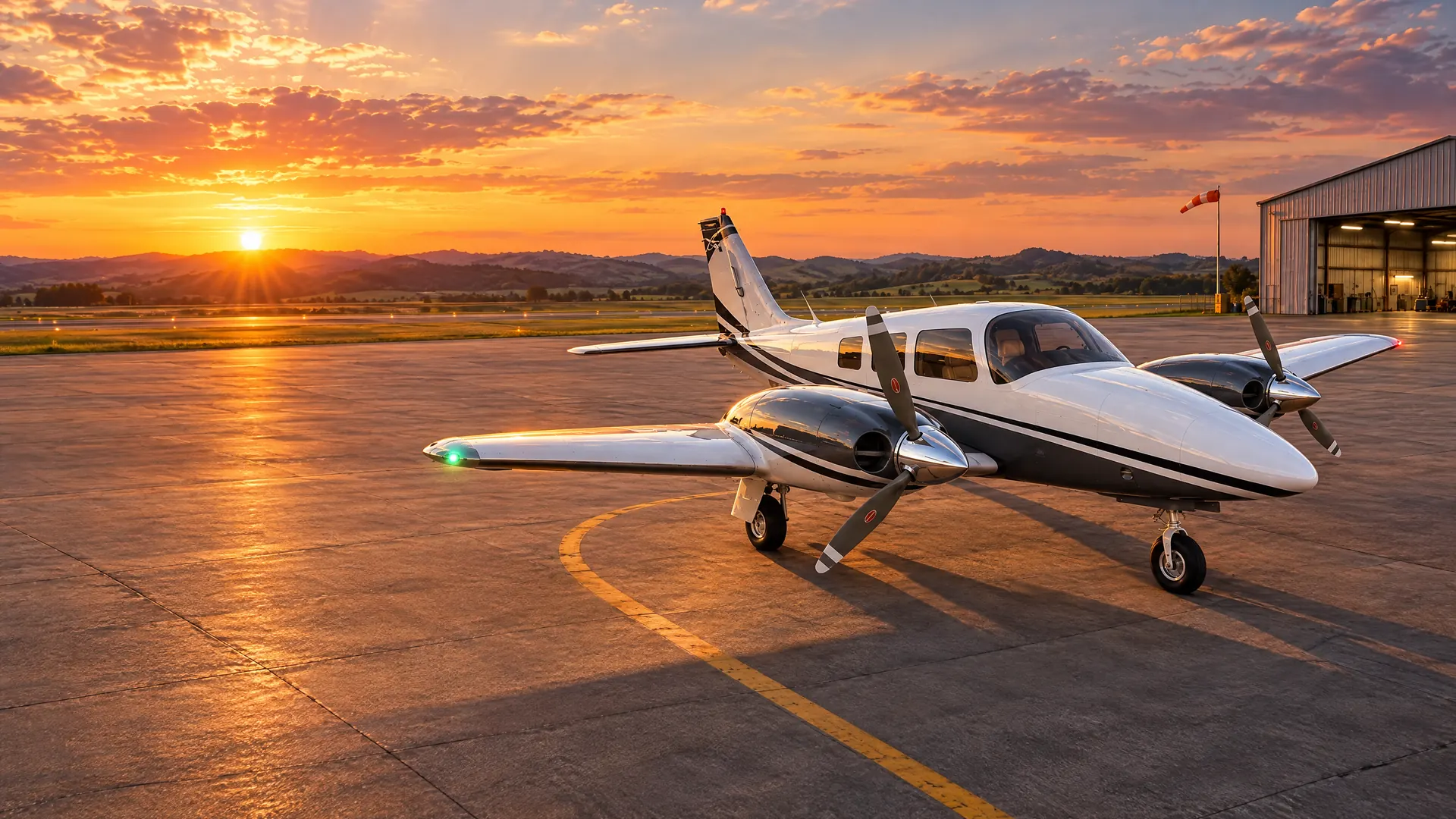
- Twin piston
- Regional routes
- Up to 5 passengers
Piper Seneca III: Specs, Range and Charter
The Piper Seneca III is a turbocharged twin for small groups on regional routes, with the lowest hourly cost in our fleet. See the aircraft data and request a quote.
- passengers plus 1 pilot, depending on operation
- 5
- reference cruise at 10,000 ft
- 319 km/h
- range with optional tanks
- 1,400 km
- turbocharged Continental engines
- 2 × 220 hp
The Piper Seneca III for regional travel
The Piper Seneca III is a twin piston aircraft with two turbocharged engines rated at 220 hp each for takeoff. In a six-seat layout it can carry up to five passengers and one pilot, depending on the aircraft and trip conditions. For small groups it is a charter option on regional routes: business trips, visits to rural properties and family weekends.
When choosing a Seneca, look beyond the number of seats. The distance from the airport to your final destination, the amount of baggage and whether the leg can be flown nonstop all help decide if it fits your itinerary.
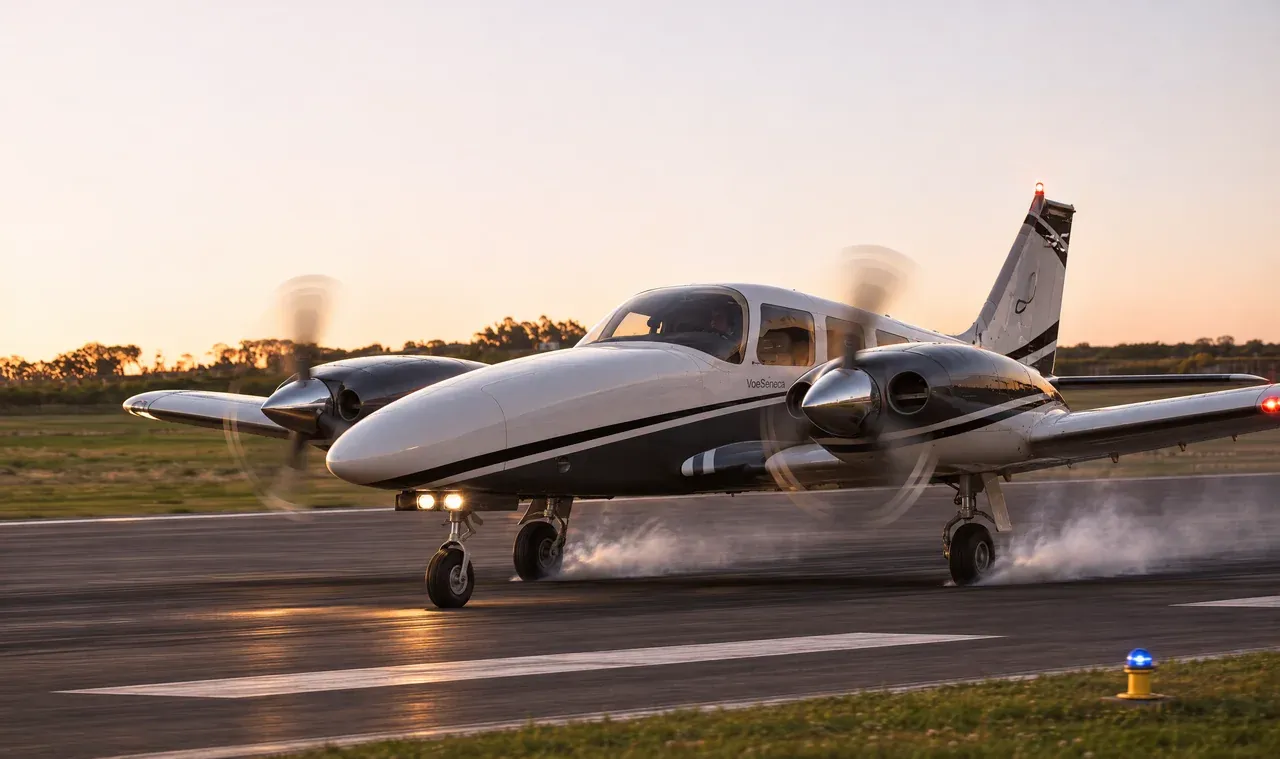
Meet the Seneca 3
The Seneca III belongs to the Piper Seneca family, developed from the PA-34. The PA-34-220T Seneca III was approved in December 1980 and, compared with the Seneca II, brought changes to the engines, windscreen, instrument panel and landing gear.
It has retractable landing gear and two Continental engines, one on each wing. Turbocharging helps maintain power at altitude. The cabin is unpressurised and boards through a rear door. In Brazil, the locally built EMB-810D, derived from PA-34-220T kits, is also known as the Sêneca III.
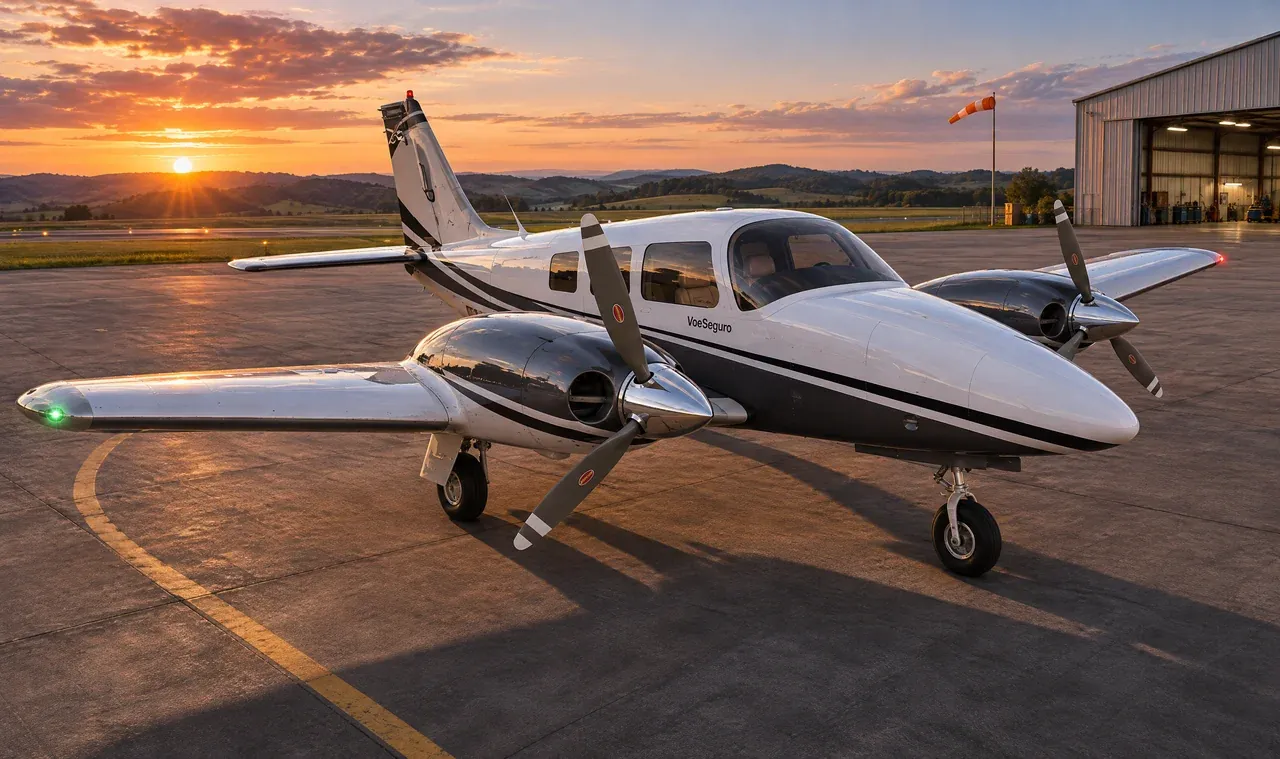
Piper Seneca III specifications
| Specification | Reference value |
|---|---|
| Manufacturer | Piper Aircraft |
| Model | PA-34-220T Seneca III |
| Category | Turbocharged twin piston aircraft |
| Capacity in six-seat layout | Up to 5 passengers and 1 pilot, depending on operation |
| Cabin | Unpressurised |
| Engines | Continental TSIO-360-KB (left) and LTSIO-360-KB (right) |
| Takeoff power | 220 hp per engine, 5-minute limit |
| Maximum continuous power | 200 hp per engine |
| Reference cruise speed | 172 kt (approx. 319 km/h) at 10,000 ft |
| Economy cruise range | 756 nm (approx. 1,400 km), optional tanks, 45-min reserve |
| Maximum operating altitude | 25,000 ft (7,620 m), with required equipment |
| Maximum takeoff weight | 4,750 lb (approx. 2,155 kg) |
| Usable fuel | 93 US gal (approx. 352 L) standard or 123 US gal (approx. 466 L) with optional tanks |
| External dimensions | 8.72 m × 11.83 m × 3.01 m (length × wingspan × height) |
Speed and range come from different scenarios in the Piper manual. Trip performance depends on weight, winds, available fuel and aircraft configuration.
What is the Seneca III range?
With 123 US gallons of usable fuel, the Piper manual shows an example of 756 nm, about 1,400 km, at economy cruise at 10,000 ft with a 45-minute reserve. With the standard 93-gallon tanks, another example shows 625 nm, about 1,158 km, under different altitude and power settings.
To know if the Seneca III can fly your route nonstop, send the route, number of passengers and expected baggage. These determine how much fuel can be carried and whether a stop is needed.
How far the Seneca III flies from Curitiba
Straight-line distances from Afonso Pena Airport, compared with the aircraft’s reference range.
- Florianópolis250 km — Within reference range
- São Paulo330 km — Within reference range
- Porto Alegre530 km — Within reference range
- Foz do Iguaçu530 km — Within reference range
- Rio de Janeiro680 km — Within reference range
- Asunción840 km — Within reference range
- Belo Horizonte850 km — Within reference range
- Brasília1,080 km — Within reference range
- Punta del Este1,180 km — Fuel stop to be assessed
- Buenos Aires1,370 km — Fuel stop to be assessed
- Salvador1,810 km — Fuel stop to be assessed
- Recife2,450 km — Fuel stop to be assessed
The actual route is longer than a straight line. Whether a leg can be flown nonstop depends on passengers, baggage, winds and fuel reserves, all assessed in the quote.
Seneca cabin
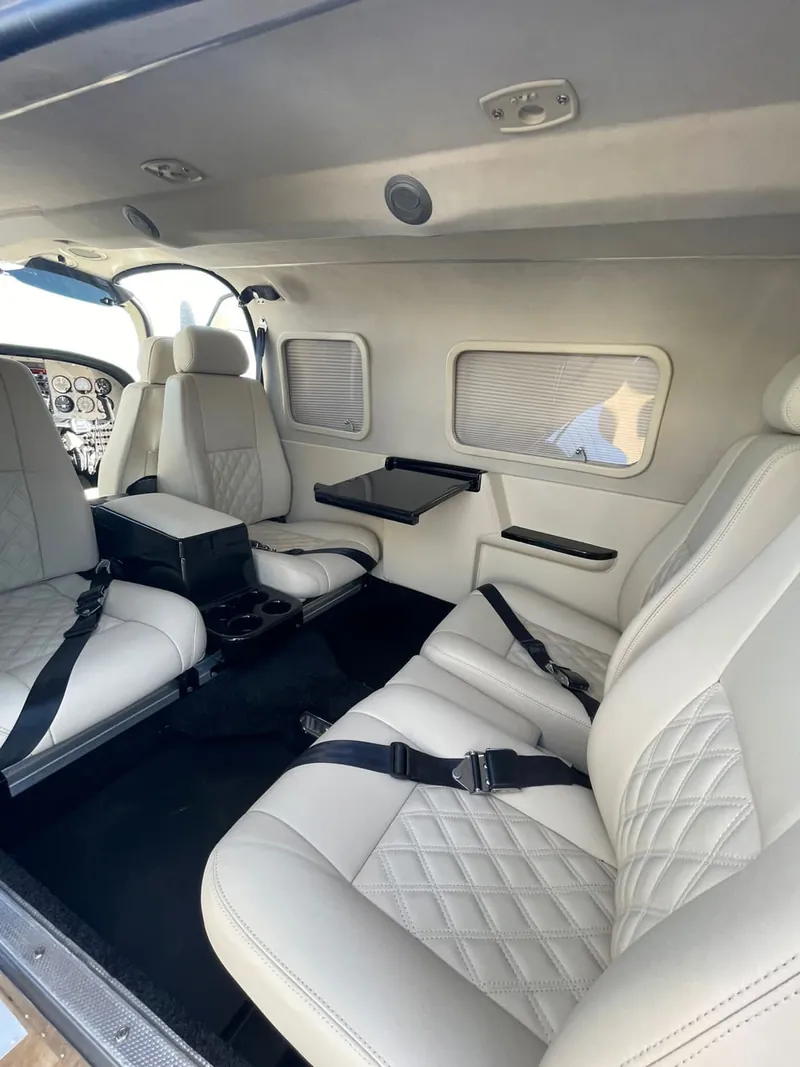
The Seneca III cabin has six seats, with leather club seating and a rear door that makes boarding passengers and baggage easier. It is unpressurised, so it flies at lower altitudes than a turboprop such as the King Air.
Space is compact, so soft bags fit best. Include baggage volume and weight in the quote: on the Seneca, weight on board directly affects the fuel available for the leg.
When to charter a Seneca
A Seneca makes sense when a few people need to travel together and the destination is far from an airport with convenient airline service. Think of a team visiting a site in the countryside and returning the same day: landing closer cuts drive time.
Using a regional airfield depends on runway and operating conditions: available length, elevation, temperature and takeoff weight. When comparing proposals, consider total door-to-door time, not just time in the air.
Request a Seneca III quote from Aviattion
Know where you are flying from and to? Send your itinerary to Aviattion to check Seneca III availability and receive a charter proposal.
How much does it cost to charter a Seneca III?
The price varies with origin, destination, dates, aircraft availability and positioning. On a round trip, the time between legs can also affect the quote. Among our fleet, it has the lowest cost per flight hour.
To receive a proposal from Aviattion, send the departure city or airport, destination, dates and times, number of passengers and baggage.
How to charter with Aviattion
- 01Send your itineraryOrigin, destination, dates, times and number of passengers.
- 02Get your proposalAvailable aircraft, estimated flight time and total price.
- 03Confirm the flightWe handle flight planning and operational approvals.
- 04BoardArrive shortly before departure and take off with no queues.
What goes into the quote
- Origin, destination and stops along the way
- Dates, times and the gap between outbound and return
- Number of passengers and baggage
- Aircraft availability and positioning
- Airport fees and crew overnight stays
Compare the aircraft in our fleet
Reference values for each model. The right aircraft depends on the route, the number of passengers and the baggage.
| Aircraft | Type | Passengers | Cruise speed | Reference range | View specs |
|---|---|---|---|---|---|
| Hawker 400XP | Light business jet | 7 | 833 km/h | 2,711 km | View specs → |
| Citation Ultra V | Light business jet | 8 | 741 km/h | 2,593 km | View specs → |
| King Air B200 | Twin turboprop | 7 | 535 km/h | 2,606 km | View specs → |
| King Air C90 | Twin turboprop | 5 | 411 km/h | 1,700 km | View specs → |
| Seneca III | Twin piston | 5 | 319 km/h | 1,400 km | You are here |
How many passengers fit in a Piper Seneca III?
In a six-seat layout, the Seneca III can carry up to five passengers and one pilot, depending on the interior, crew and weight limits for the route.
What is the difference between the Seneca II and the Seneca III?
The Seneca II is the PA-34-200T and the Seneca III is the PA-34-220T, with 220 hp Continental engines for takeoff and changes to the panel, windscreen and landing gear.
Are the Seneca III and the EMB-810D the same aircraft?
The EMB-810D is the Brazilian version derived from Piper PA-34-220T kits and is also known as the Sêneca III. Confirm the designation and data of the offered aircraft.
Is the Seneca pressurised?
No. The Seneca III cabin is unpressurised; turbocharging keeps engine power at altitude, but it flies lower than pressurised aircraft.
How much does it cost to charter a Seneca III?
It depends on the itinerary, dates, availability and positioning. It is the lowest-cost option per hour in our fleet. Send your itinerary to receive a proposal.
Sources for the technical data: Piper flight manual (PA-34 Owners), New Zealand CAA, NTSB, Guatemala DGAC and ANAC.